
Beyond the Bulletin Board: Getting Title IX Notices Right
Why it Matters
It is easy to dismiss a flyer or poster as background noise, something people walk past a hundred times without really seeing. But in the context of Title IX, that piece of paper can carry more weight than its size suggests.
For a child who has experienced or witnessed misconduct, the moment of deciding whether to say something is often quiet and uncertain. There is no announcement, no obvious cue that this is the moment to act. A poster that clearly names what counts, who to go to, and what will happen next can be the thing that turns hesitation into a decision to come forward. For a student who does not yet realize that what happened to them has a name and a process, it can be the first signal that they are not without options.
Students are not the only audience that matters here. Staff need their own version of this clarity, and their poster should focus on a different question entirely: not what counts, but what they are required to do about it. Every adult on campus is a mandated reporter, and that obligation is easy to forget in the middle of a busy day or a confusing moment. A staff-facing poster should reinforce that duty clearly, outline exactly how and when to report, and address what to do, and what to avoid, when a student discloses something to them directly. This is information that needs to be visible in staff lounges, offices, and anywhere adults are likely to be reminded of their role.
Posters also do something less visible but equally important. They communicate, simply by existing and being done well, that the school or other federally-funded institution has thought this through. That reporting is not an afterthought. That the institution understands its obligations and takes them seriously enough to make sure every student and staff member knows where to go.
None of this means a poster does the work alone. But it lowers the barrier at the moment that barrier matters most, and that is worth getting right.
There is also no rule limiting how many of these posters an institution can put up, or where. Hallways and front offices are the obvious choices, but bathroom stall doors, cafeterias, locker rooms, classrooms, and gyms are all worth considering too. There is real value in repetition and reach here, not just placement in a single visible spot.
Start With What Counts as Misconduct
Students cannot report what they do not recognize. A surprising number of posters skip this step entirely or bury it in dense legal language. The most effective ones define sexual harassment in plain terms and give concrete examples, not just legal categories like "hostile environment," but actual behaviors: unwanted comments, sharing images without consent, persistent unwanted contact.
The goal is recognition, not legal precision. A student who sees their situation reflected in an example is far more likely to understand that what happened to them counts.
Make Reporting Options Clear
Every effective poster answers the same basic question: where do I go? But the best ones go further by offering more than one path, because not every student will feel comfortable with the same option.
That typically means naming a specific Title IX coordinator with direct contact information, not just a department, but a person. It also means listing alternative reporting paths, including counselors, trusted teachers, administrators, or a school resource officer, along with anonymous reporting tools like a QR code or tip line for students who are not ready to come forward by name.
Explain What Happens Next
This is the piece most posters miss entirely, and it may be the most important one. Students are often hesitant to report not because they doubt something happened, but because they have no idea what reporting actually leads to. Will their parents be told? Will they have to face the other person? Will anything actually happen?
A good poster walks through the basics: that the student will be connected with supportive measures regardless of whether they file a formal complaint, that they have a right to an advisor, that an investigation will be conducted if pursued, and that retaliation is prohibited. This does not need to be exhaustive. It needs to be enough to lower the fear of the unknown.
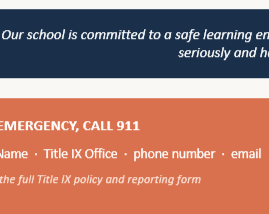
State the School's Commitment Directly
A line affirming the school's commitment to safety might seem like boilerplate, but it serves a real purpose. It tells students that reporting will be met with seriousness rather than dismissal, and it sets a tone of accountability that the rest of the poster can build on.
Resist the Urge to Include Everything
Some of the most thorough posters fail for the opposite reason: they try to cover every possible category of misconduct, every procedural step, every right and obligation, all on one page. The result is something dense enough that no one actually reads it.
A poster is not a policy manual. Its job is to orient, not to educate comprehensively. The most effective ones lead with the few things a student or staff member absolutely needs to know in the moment, and point toward where to go for the rest. A QR code linking to a fuller policy page or detailed procedural document does more good than trying to cram everything onto a single sheet.
Design Matters More Than People Think
A poster that is visually cluttered or text heavy will be skimmed at best and ignored at worst. Clear hierarchy, readable fonts, and enough white space to make the page approachable all affect whether the information actually gets absorbed. This is not a cosmetic concern. It is part of whether the poster does its job.
The Bigger Picture
A well-designed Title IX poster will not, on its own, prevent misconduct or guarantee that kids come forward. But it removes friction at a moment when friction often wins. A minor who is unsure who to tell, what counts, or what will happen next is a minor who may decide it is easier to say nothing.
Getting the poster or flier right is a small thing institutions can control completely, and it is worth doing well.
Need Help Getting Started?
If your current notices could use a refresh, or you are starting from scratch, we can help. Remember, the goal is to create and display information that kids and staff actually read, understand, and act on.
Does your website comply with TIX requirements? Read this blog to find out!
