The Difference Between Poor Judgment and Misconduct
In K–12 schools and child-centered organizations, not every concerning employee action is misconduct. But that doesn't mean it should be ignored.
Every organization eventually faces a moment when someone's behavior raises a red flag. Maybe an employee shared information they shouldn't have. Maybe a volunteer bent a rule to help someone out. Maybe a longtime staff member crossed a line no one thought they would cross. When that moment comes, one of the first questions leadership has to answer is this: Are we looking at poor judgment or are we looking at misconduct?
The distinction matters more than most people realize because it shapes everything that follows. It determines how you investigate, how you respond, what you document, and in some cases, what you are legally required to report. Understanding the difference can help institutions make more consistent, defensible decisions while protecting both students and employees.
Poor Judgment Isn't Always Misconduct
Poor judgment is a mistake made in good faith. Educators are human; they may exercise poor judgment, and occasionally make decisions they wish they could take back.
Examples might include:
Sending an email to a student that is overly informal.
A volunteer giving a student their phone number to be helpful.
Sharing too much personal information with students.
Being alone with a student when another option was available.
Giving a student a gift without realizing how it could be perceived.
Talking to students about their personal relationships.
These behaviors may violate district expectations or raise legitimate concerns, but they are not automatically misconduct. They often come from gaps in training, unclear expectations, inexperience, or simple human error. The person believed they were doing something reasonable, even if the outcome was not.
Poor judgment calls for coaching, clearer guidance, and sometimes retraining. It's a teaching moment, not a disciplinary crisis. Handled well, it actually strengthens the organization, because it reveals where policies and training need to improve.
Misconduct Crosses a Different Line
Misconduct involves a knowing violation of rules, policies, laws, or ethical standards. The person understood, or reasonably should have understood, that what they were doing was wrong, and they did it anyway.
Examples may include:
Grooming behaviors.
Sexual misconduct.
Inappropriate electronic communications.
Physical abuse.
Emotional abuse.
Retaliation against students or employees who report concerns.
Repeated boundary violations despite prior intervention.
Misconduct requires a formal response: documentation, investigation, and consequences that fit the severity of the behavior. In some fields, like education, healthcare, and youth services, it may also trigger mandatory reporting obligations to outside agencies.
Intent and awareness are the dividing lines. Misconduct isn't about a bad outcome. It's about a bad choice made with knowledge of the standard being broken. The focus shifts from correcting judgment to determining facts and assessing policy violations.
The Gray Area
The most difficult cases rarely fall neatly into either category. They are also the most common.
Imagine an employee who repeatedly texts a student late at night. Individually, each message may seem harmless. Together, however, they may reveal a pattern of boundary violations that warrants a much closer look.
Or consider an educator who consistently seeks opportunities to be alone with a particular student. No single interaction may constitute misconduct, but the cumulative behavior could indicate grooming or other inappropriate conduct.
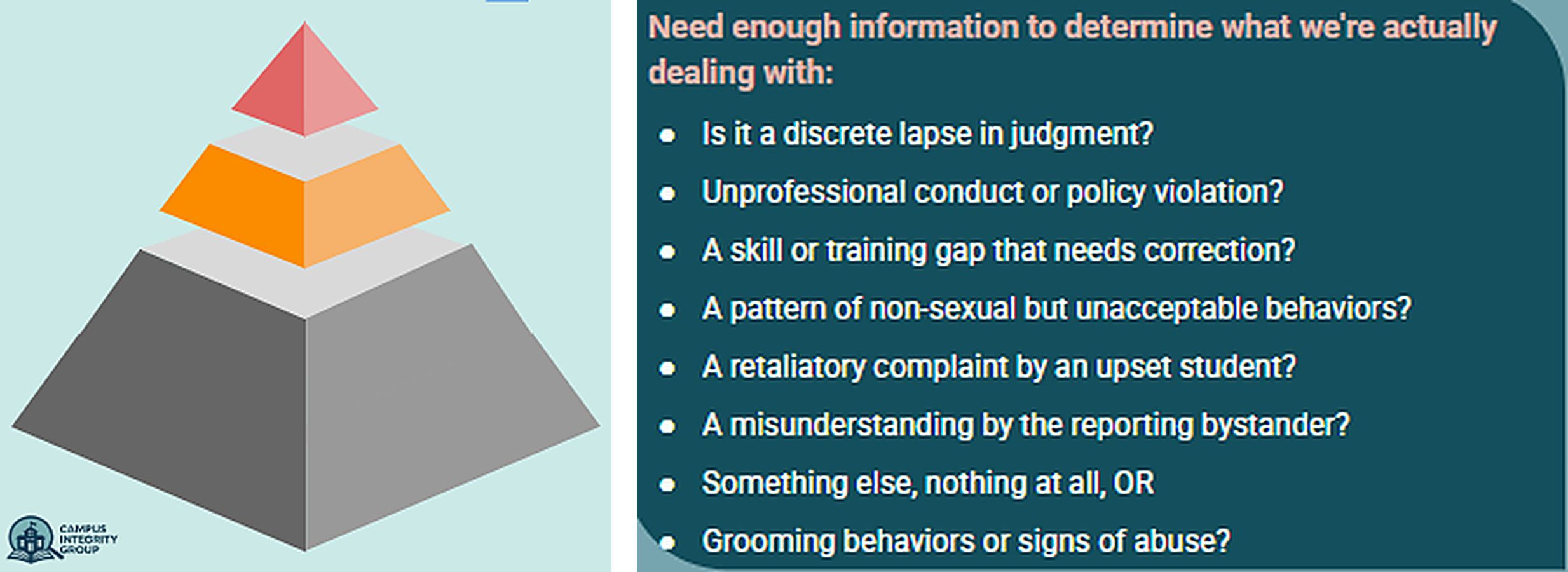
The line between poor judgement and misconduct gets particularly blurry when:
High performers are given the benefit of the doubt. Track records are not evidence of intent. The behavior itself must be evaluated on its own terms.
Assuming ignorance excuses everything. "I didn't know" only goes so far. If the expectation was clearly communicated in a policy, a training, or a signed acknowledgment, a claim of ignorance doesn't automatically downgrade misconduct to a mistake.
Discomfort drives the label. Calling something "poor judgment" is easier. It avoids confrontation and hard conversations. It usually means the institution does not have to initiate a formal process. But mislabeling misconduct to keep the peace almost always makes things worse later.
Don't Wait for a Crisis
One of the biggest mistakes institutions make is assuming they should only respond once conduct clearly qualifies as misconduct. By then, valuable opportunities for prevention may have been missed.
Addressing poor judgment early accomplishes several important goals:
Reinforces professional boundaries.
Documents concerns before patterns develop.
Protects employees from unintentionally escalating risky behavior.
Demonstrates that the district takes student safety seriously.
Helps identify situations that may require increased monitoring.
Early intervention is often one of the strongest forms of prevention.
Final Thoughts
Poor judgment is a mistake. Misconduct is a choice. One calls for guidance, the other calls for accountability.
Confusing the two can do real damage. Punishing honest mistakes creates fear and silence. Excusing real misconduct creates risk and erodes trust.