
Investigate First. Discipline Second.
When a serious concern is reported, schools and youth-serving institutions often feel pressure to act immediately.
Sometimes that pressure comes from parents. Sometimes from staff. Sometimes from administrators who want to demonstrate that the institution is taking the concern seriously. And sometimes, that pressure leads to a decision being made before the facts have been fully established.
But taking action quickly does not have to mean disciplining someone quickly. In fact, when misconduct is alleged, the investigation should come first. Appropriate discipline should follow.
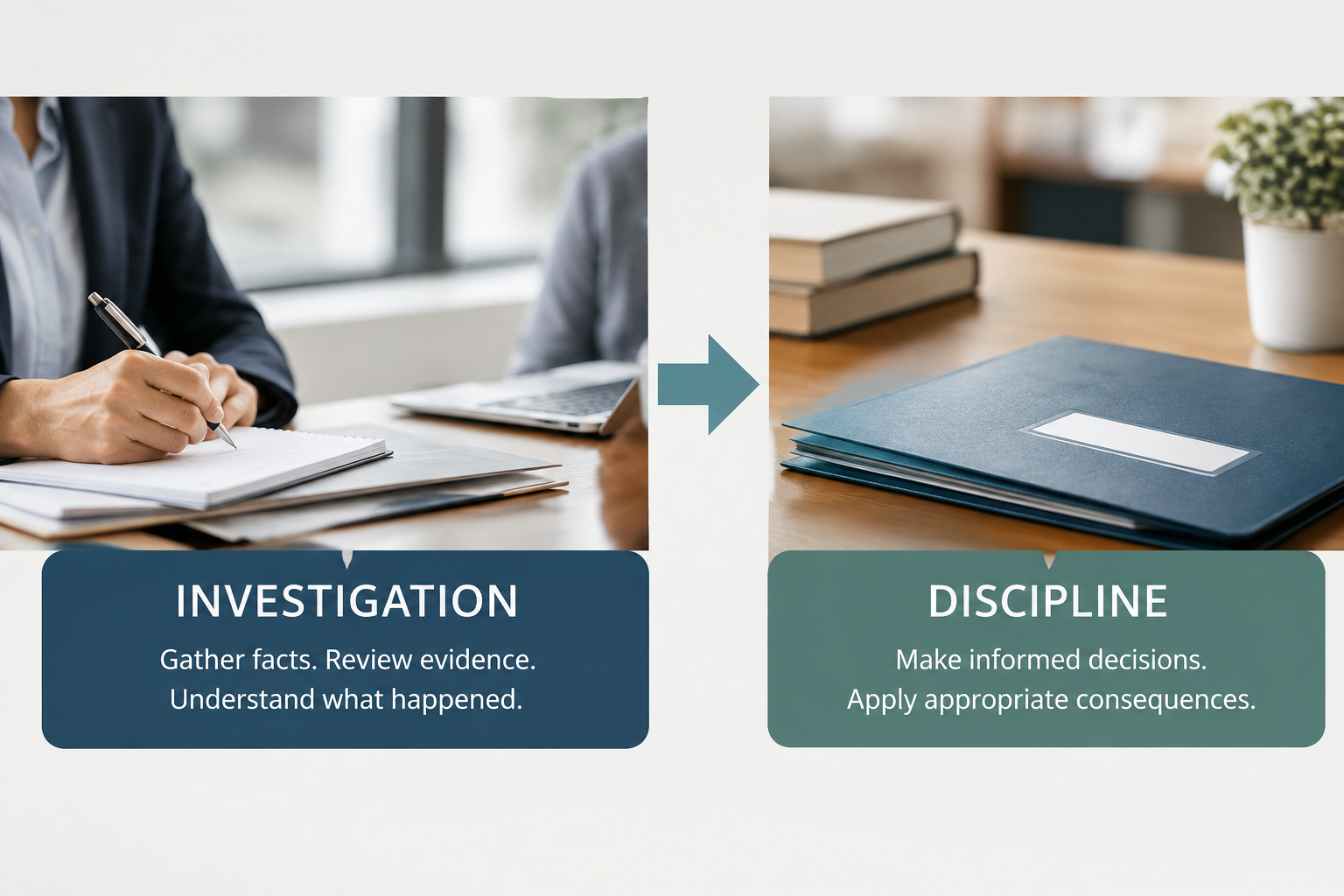
Why does the order matter?
Discipline is supposed to be a response to established facts, not a stand-in for figuring out what actually happened. When an institution jumps to a consequence before completing an investigation, a few things tend to go wrong:
The full picture may still be missing. Witnesses haven't been interviewed, documents haven't been reviewed, and the accused hasn't had a real chance to respond.
Due process gets skipped. Staff and children generally have a right to know what they're accused of and to respond before consequences are handed down, not after.
The discipline itself becomes harder to defend. If it turns out later that key facts were missed, the institution is now in the position of having disciplined someone based on an incomplete record, which opens the door to appeals, grievances, or legal exposure.
It can actually undermine the outcome you wanted. If discipline gets overturned or challenged because the process behind it was flawed, the accountability the institution was trying to create disappears along with it.
An allegation is not a finding
A child may report that a staff member made them uncomfortable. A parent may report a boundary concern. A staff member may be accused of inappropriate language, physical contact, harassment, or another form of misconduct.
The institution should take the concern seriously from the moment it is received. But taking it seriously means responding appropriately, not deciding the outcome before the investigation begins.
An investigation provides an opportunity to gather information, identify witnesses, review relevant records and communications, understand the context, and give the involved individuals an opportunity to provide information.
Only after those steps can an institution begin making informed decisions about what occurred and what response is appropriate.
Acting quickly and investigating carefully are not opposites
One of the biggest misconceptions is that an institution has to choose between protecting kids and conducting a fair investigation. It doesn't. Investigating first isn't about slowing things down for its own sake. It's about making sure that whatever decision comes next can actually stand on solid ground.
There are often immediate steps an institution can take while an investigation is underway. Depending on the circumstances, those might include adjusting schedules, changing reporting relationships, limiting contact, increasing supervision, placing an employee on administrative leave, or taking other temporary measures designed to protect children and preserve the integrity of the process.
Those actions are not the same as discipline, and that's an important distinction.
Interim measures address immediate concerns. An investigation addresses the facts. Discipline addresses substantiated misconduct.
Keeping those purposes separate helps institutions respond both promptly and appropriately.
What happens when discipline comes first?
When an institution jumps directly from allegation to discipline, it can create problems on multiple levels.
The facts may not be what they initially appeared to be.
Initial reports are often incomplete. People may misunderstand what they observed. Context may be missing. Witnesses may have different accounts. Records or communications may provide information that wasn't known when the complaint was first made.
An investigation is designed to uncover those details.
The response may not match the conduct.
Not every policy violation is the same. Not every boundary concern has the same level of seriousness. Context, intent, history, impact, and other circumstances may matter when determining an appropriate response.
Without a thorough understanding of what happened, discipline can become disconnected from the actual conduct.
The process may become difficult to defend.
When an institution has already decided what happened, an investigation can begin to look like a formality rather than a genuine effort to determine the facts.
That can undermine confidence in the process, not only for the accused employee, but also for children, families, staff, and anyone else involved.
The goal isn't to protect the employee from consequences.
Investigating before disciplining isn't about being lenient. It isn't about delaying action. And it isn't about giving someone the benefit of the doubt at the expense of child safety. It is about making sure the institution understands what happened before deciding what should happen next.
If an investigation substantiates serious misconduct, the institution should be prepared to respond appropriately. The strength of that decision comes from the process used to reach it.
A strong process protects everyone.
A well-conducted investigation doesn't just protect the person who has been accused. It protects kids by creating a structured process for taking their concerns seriously and determining what occurred. It protects institutions by helping administrators make decisions based on evidence rather than assumptions. And it protects the integrity of the outcome by creating a clear record of how the institution moved from allegation, to information gathering, to findings, to action.
The question shouldn't be, "How quickly can we discipline this person?" It should be:
"What do we need to do right now to keep people safe, preserve the integrity of the process, and determine what actually happened?"
That approach may still lead to discipline. But when it does, the decision is grounded in something much stronger than an allegation.
It is grounded in an investigation.
Not sure where to start? Our Non-Title IX Investigation Plan and Checklist will walk you through how to run a thorough investigation from the very first report, whatever the complaint involves.
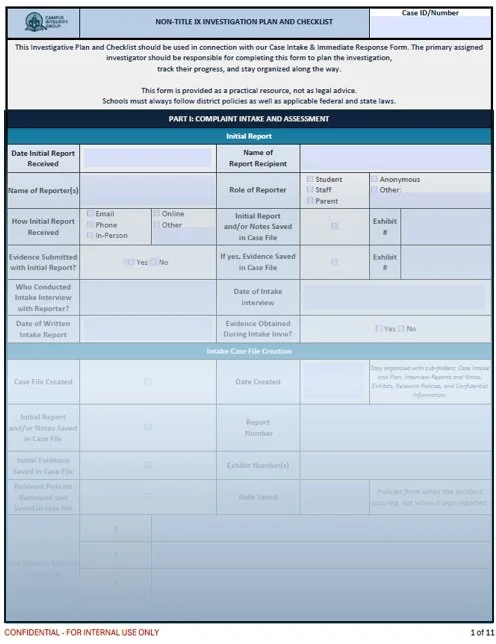
Run a clean investigation from day one, no matter the allegation.
The Non-Title IX Investigation Plan & Checklist is a fillable (and reusable) PDF document and master planning tool based on Campus Integrity Group’s experience leading more than 2,500 K-12 staff misconduct investigations. It is designed for complaints outside Title IX that still demand a structured, transparent, well-documented process. Whether the concern involves staff conduct, boundary issues, bullying, harassment, corporal punishment, racial or national origin discrimination, or other policy violations, this guide helps schools track every step with clarity and control.
What it does:
Fillable PDF document that can be used in any and all investigation
Defines scope, assigns roles, and sequences tasks
Maps each step, from identifying witnesses and evidence to logging interviews and numbering exhibits
Sets timelines and milestones, with space for supervisor feedback and updates to the parties
Monitors progress to completion for a defensible record
Result: consistency, accountability, and a clean file from intake to case closing.
Versions:
Standard: ready to use across districts (this version).
Customized: tailored to your systems and structure, including file-naming rules, case-management workflows, and supervisory review protocols. See here to learn more.
