The Cheapest Safety Upgrade: A Simple Complaint-Tracking System
Schools are flooded with information every day: test scores, attendance flags, local and national news, parent concerns, student disclosures, staff grievances, anonymous tips, hotline calls, nurse visits, bus referrals, and the kind of HR chatter that never makes it into a formal process.
When concerns involve staff misconduct, some reports must be addressed promptly under federal law, including Title IX sexual harassment and Title VI racial discrimination. Building the bandwidth to consistently track and triage every concern, not just the ones that trigger a formal process, improves student safety, reduces institutional risk, and spotlights the areas where a district needs clearer expectations, tighter supervision, or targeted training.
A simple, consistent complaint-tracking system is one of the cheapest, most effective safety upgrades a district can make.

Why tracking matters
Many high-impact cases begin as vague reports:
“He makes her uncomfortable.”
“She doesn’t want to be in that class anymore.”
“He’s overly friendly.”
“I don’t know if this is anything, but…”
If you do not log those early signals, you lose the ability to connect dots over time. The second or third report is often where the picture becomes clear. If the first two were never recorded, leadership looks at the third one like it came out of nowhere.
“Not Title IX” does not mean “not a problem”
A lot of harmful conduct lives outside any single regulatory box. Boundary violations, grooming behaviors, retaliation, repeated inappropriate comments, favoritism, off-campus misconduct, and complaints about former staff members can still create safety risks and liability.
Tracking creates institutional memory beyond whichever administrator happened to receive the email.
Tracking protects students and staff
This cuts both ways in a good way. Students benefit because patterns get noticed sooner, interventions happen earlier, they feel heard and supported, and repeated misconduct is harder to ignore. Staff benefit because documentation prevents rumor-based decision-making. If a report is unsubstantiated or resolved, or is the result of a misunderstanding, the record should reflect that clearly and fairly.
Identifying low-level concerns also gives administrators the chance to have an early, counseling-style conversation with the staff member involved. Most well-intentioned staff will adjust their behavior once they learn they are making someone uncomfortable or doing something that is not aligned with district standards. But if the conduct continues after that kind of clear guidance, that persistence is its own data point, and it often means the issue needs to be escalated anyway.
It supports a positive school culture
Tracking and responding to low-level complaints supports a school’s culture because it shows students, families, and staff that speaking up is taken seriously, even when the issue seems “minor.” Encouraging reporting only works when people actually feel heard, the process that follows is fair, and the response is appropriately scaled to the concern. When students, staff, and parents see that kind of follow-through in real time, trust grows and they understand that administrators mean what they say about safety, accountability, and respect.
Destigmatizing Tracking
A complaint log is not a direction to investigate, a formal finding, or punitive in nature. It is simply a way to capture that a concern was raised and to document what the school did next, so everyone involved in intake understands the purpose is consistency and accountability, not automatic escalation.
Further, a well-kept log can just as easily protect staff and squash rumors: if it shows, for example, that the same parent has raised similar complaints about every teacher their child has had over several years, that pattern gives decision-makers critical context to calibrate an appropriate response.
What should be tracked?
You do not need a fancy case management platform to track complaints and collect usable data. You do need a simple system for administrators across the district to log concerns in a uniform manner that can be accessed by decision-makers.
At minimum, track:
Date received and how received (in person, email, hotline, anonymous tip, etc.)
Reporter (name and contact, or “anonymous”)
Student(s) involved (limit access to those with a legitimate need to know)
Subject of concern (employee, volunteer, student, visitor)
Brief allegation summary (neutral language, no conclusions)
Employment status (active, suspended/on leave, reassigned, resigned)
Category tags (examples: boundary concern, retaliation, harassment, discrimination, physical contact, online contact, supervision lapse)
Assigned owner (who is responsible for next steps)
Triage decision (monitor, refer to HR, refer to Title IX team, informal resolution, full investigation, law enforcement report, mandated report, etc.)
Outcome/status (open, closed, referred, unfounded, policy violation found, resolved with supports)
The key is consistency. If every department and school building tracks differently, you cannot see patterns.
Bottom line
Tracking also does not create liability when it is paired with reasonable, timely action. The liability comes from not tracking, missing patterns, and then looking unprepared or indifferent when an issue escalates.
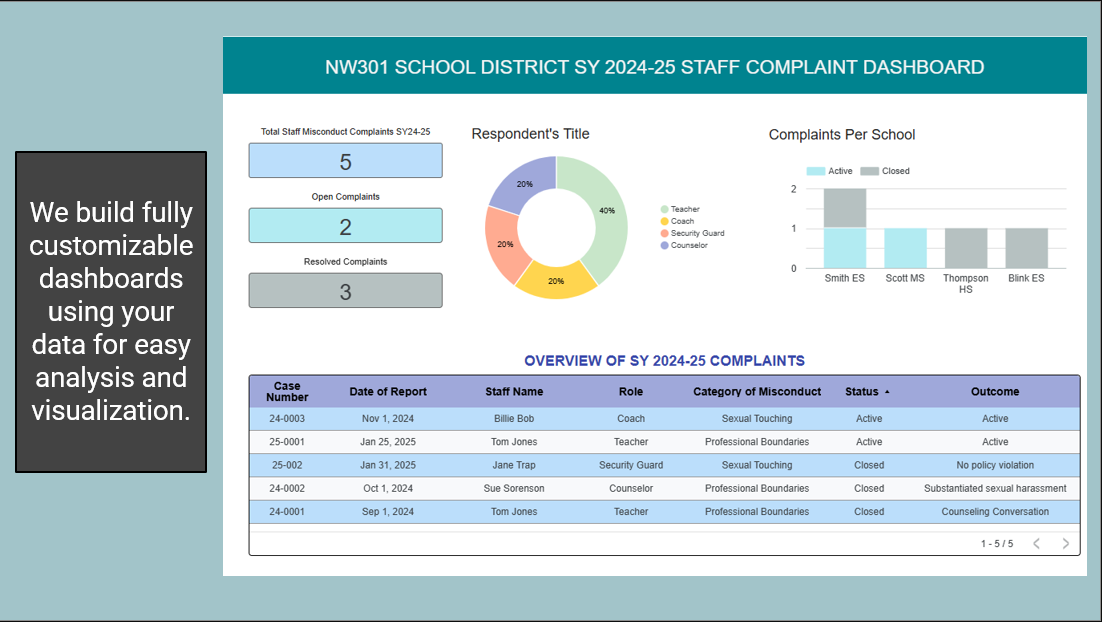
Campus Integrity Group has built user-friendly, fully customizable complaint-tracking systems, and we’re happy to help. We can assess your current intake and documentation process, design a streamlined districtwide log with clear categories and escalation triggers, train the staff who receive complaints, and help you build a response workflow that’s consistent, fair, and appropriately scaled. If you’d like to learn more, contact us to schedule a brief call and we’ll walk through options based on your size, staffing, and priorities.