
Fire First, Investigate Later: a Risky Response to a Staff Arrest
Each week, we see headlines about school staff arrested for sexual abuse or other misconduct involving students or other children. And almost immediately, districts issue a familiar statement: the employee has been fired.
We understand the instinct to fire first and deal with the aftermath later. School leaders may think it will bring comfort to a rattled school community, mitigate reputational damage, and portray decisive decision-making. But firing first can backfire big time. It can create legal complications (especially if the charges are dropped), violate Title IX, and convey a hasty and incomplete response.
Instead, districts should plan for a multi-phase response that communicates necessary information to the school community as things develop.
Priority Action Steps and Messaging
Student safety is a top priority. Show this through actions, not just words. Place the alleged offender on administrative leave, remove access to students, or accept their resignation. Convey to the school that students are not at risk of further harm, support is available, offenders will be punished after a fair and thorough investigation, and the school is working to identify what went wrong so it can be fixed ASAP.

Follow-up communications:
We followed policy and Title IX requirements.
We investigated thoroughly and fairly.
We looked for other victims and other involved staff.
We reported what we were required to report.
We made findings based on applicable laws and school rules.
We corrected system failures to reduce future risk.
We held all bad actors accountable. Whatever it is, the way you tell your story online can make all the difference.
Criminal charges do not equal school findings
The criminal system answers one question: did this person violate criminal law beyond a reasonable doubt? A school has to do its own investigation to answer different questions, using different standards, and relying on its own policies.
School policy violations can exist even if a prosecutor declines charges, a case is delayed, or a jury acquits.
Title IX and related district policies focus on whether prohibited conduct occurred and whether the school responded appropriately.
Employment decisions must be grounded in the district’s rules, contracts, and procedures, not just a police report or a news article.
Bottom line: districts cannot outsource their responsibilities to the criminal system.
If it is a Title IX matter, do not skip straight to discipline
If the allegations constitute sexual harassment or sexual violence under Title IX and district policy, the district generally cannot impose final disciplinary action based solely on an arrest. Schools still have to do the work:
Assess jurisdiction and policy coverage (Title IX, state law requirements, board policy, staff code of conduct, mandatory reporting rules, child abuse reporting laws, etc.).
Provide a fair, thorough investigation aligned with the school’s grievance process and any collective bargaining requirements.
Make findings based on school policy, using the applicable standard of evidence and definitions.
Engage the school’s disciplinary process.
Skipping due process requirements when a case feels like a “slam dunk” can backfire fast: flawed process leads to overturned discipline, litigation risk, and a community that loses trust.
Expand the scope beyond “this one person”
Arrests often reveal a bigger problem: patterns, blind spots, and enablers. There is no time sensitivity to this inquiry once the alleged offender’s access to students has been cut off pending the outcome of the criminal process and administrative investigation.
A proper school investigation should actively seek out:
Other potential victims (including former students, students who transferred, or students in extracurriculars)
Other potential bad actors (staff who engaged in grooming behavior, boundary violations, or related misconduct)
Supervisory failures (who missed warning signs, who minimized concerns)
Adults who knew and did not report (mandatory reporters, supervisors, coaches, colleagues)
Close the loopholes
If hindsight is 20/20, use that lens to study what you’ve learned in your investigation. What went wrong and, just as importantly, what went right? Focus on potential weak spots to help prevent a similar misstep in the future, and reinforce the decisions of staff who acted with student safety as a priority. Areas to review:
Reporting pathways
Were students and staff clear on how to report?
Did they trust the process?
Training quality
Was training check-the-box, or did it teach staff what grooming actually looks like?
Were warning signs overlooked?
Policies and Professionalism
Do policies address texting, DMs, social media, gaming platforms, and personal email?
Are staff clear on what is - and is not - an appropriate student interaction or relationship?
Volunteer and contractor oversight
Are non-employees getting access without adequate checks?
Hiring and exit practices
Are resignations documented with findings?
Are reference checks meaningful, or just procedural?
Data and early warning
Does the district track boundary concerns, repeat complaints, and patterns across schools? Does it look for repeated complaints against the same person?
Having a staff member arrested for shocking alleged offenses can be traumatic to all involved. Campus Integrity Group can help. We can step in to conduct swift, thorough and compliant investigations; identify and strengthen potential weak spots; conduct systemic reviews; improve policies to close loopholes, and more.
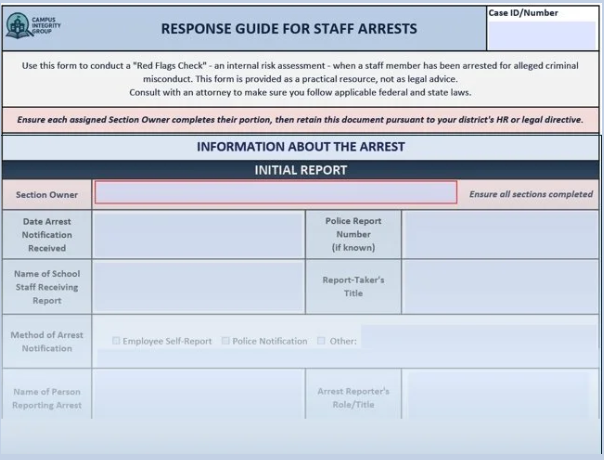
Not sure where to start?
Our Response Guide for Staff Arrests walks school leaders through the critical decisions, notifications, and responsibilities that come into play after a staff member is arrested for alleged criminal conduct, whether on or off campus.
At the center of the Guide is the Red Flags Check, an internal review that looks at personnel files, prior complaints, background check history, disciplinary records, and feedback from supervisors, colleagues, and students.
